
Our schools are filled with phenomenal teachers who use a wide set of tools available to deliver content. When you walk in a classroom, you observe students raising their hands with the right answers. You read essays that are solid examples of writing. Students’ homework and grades are strong.
Yet, educators are deeply concerned about AI. In conversations with colleagues, the concern that young people can’t think independently comes up repeatedly. Instead, these students and recent graduates turn to AI for advice and understanding when we might once have expected them to reach out to a mentor or peer. The gap between production and understanding keeps getting wider.
But what if students are producing exactly what the system is designed for them to produce? Following, I’ll provide several scenarios that explore how the very systems we provide are affecting the results we currently receive.
Every Educator Is a Systems Designer
Teachers arrange student desks in clusters and assign seats to influence peer-to-peer interactions. Leaders design the daily schedule to ensure sufficient seat time, give teachers breathing room, and provide the unique experiences your community needs. Administrators structure the school communication plan across all divisions to affect parent understanding, trust, and branding.
Desk arrangement, daily schedules, and communication plans are all systems at different scales. A system is simply the collection of connected rules, expectations, structures, constraints, and opportunities that influence how people behave.
A system can be as small as the process by which students turn in an assignment to as large as developing talent pipelines for teachers and staff. These systems don’t exist in isolation; they interact and influence one another at every scale.
As educators, we already design systems and, in fact, are experts at it. Our systems are often inherited, designed to solve an old problem. Consider these scenarios.
- The current math curriculum may be widely used, with parents having the teacher edition at home. Perhaps that math curriculum was the best for its time, teaching processes well with amazing review sections. However, students in the upper grades are struggling to see math as anything more than a series of facts.
- The daily schedule you operate with was made by a committee 20 years ago that no longer works at the school. That daily schedule is becoming constraining to a cohort of students who would benefit from an experiential learning program. Yet, the current schedule doesn’t allow the opportunity to leave campus to participate in and learn from the experience.
- A donor gives restricted funds to support instructional technology in the classroom, yet you have devices collecting dust in the IT closet. The repeat major donor wants new devices in the classroom for their grandchild, believing this is the next best thing. You know the teachers are at capacity and recognize the new tech will struggle to take off with your current curriculum. You’re left concerned saying “no” now may hinder future asks of the donor.
It’s imperative, but often overlooked, that we make time to pause to examine what these systems are producing. Are the outcomes aligned with our school mission and the promise we make to our students, families, and other constituents?
Good Intentions, Unintended Outcomes
It’s not just legacy systems and outside constraints that can yield unintended outcomes. Sometimes we bring together all our talents, experience, and passion to make what we think is “the best thing ever,” only to discover weeks later that we’re not seeing expected behaviors.
Take a grading system for an English classroom for a unit on a text like To Kill a Mockingbird. You want to build the students’ skills to analyze the characters in the text, connecting to the author’s lived experiences and character development. You expect students to read, conduct question and answer work to help them interpret, and connect their thinking through worksheet activities.
You set up grades assessing the thesis statement, the first draft, and the final paper. You teach your lessons and set clear pacing guidelines. You communicate the expectations and break down the requirements in a clear rubric with specific instructions about what they are supposed to produce.
The student going through the above described system for the lesson on To Kill a Mockingbird is going to take the most efficient route for what defines success. For some students, success is earning the highest grade possible. For others, a “C” grade will suit just fine, while others simply want to complete the work before soccer practice. Students will adapt their behavior to whatever the system makes consequential.
The consequential part in this case is the grades attached to the outputs: the thesis statement, first draft, and final paper. When reviewing the products, you’re left with a sinking feeling that the work could be written by either AI or the student. What was the output that your system you designed ultimately produced? AI doesn’t produce this problem; it only makes it glaringly visible.
In another example, an observation system scores teachers on the growth students achieve over the course of a school year, as measured by pretests and posttests. Teachers and administrators work together to draft the tests and align them to classroom standards. It’s all well-intentioned, leaving faculty and administration feeling good about the initiative.
Then, reality sets in. An influential teacher has a strong group of students who earn an 80% on the pretest and a 90% on the posttest, resulting in a low growth score. While the administration reassures the teacher that this is a strong group of students and are unconcerned, the low growth score sticks with the teacher. This system creates an unintended consequence: the teacher begins administering the pretest long before the students can know anything about the subject at hand. The teacher later coaches students the day before the posttest. The result yields artificial highs and lows. While the content is the same, and students are still exposed to the same material, the end goal shifts to navigating the system as efficiently as possible. The teacher wants the score to match the reality they and the admin expect.
The problems we usually see day-to-day in our schools are rarely student, teacher, or staff problems. It is simply a human response system. Good people, operating in well-intentioned systems, can still produce unintended outcomes.
Putting the Human Experience Back at the Center
Education has long had well-intentioned systems in need of updating. In my own work, I’ve seen the human element as the solution, with our systems placing the human experience at the center. Humans navigate our systems. Good design begins with observing how these systems will be experienced by humans.
This sentiment is echoed in works such as the Future of Education Report, Readocracy’s work on critical AI literacy, and the Portrait of a Teacher brain trust. While each approaches this challenge differently, all have reinforced for me the importance of empathy, human connection, and focusing on the process of learning over the outputs and products traditionally emphasized.
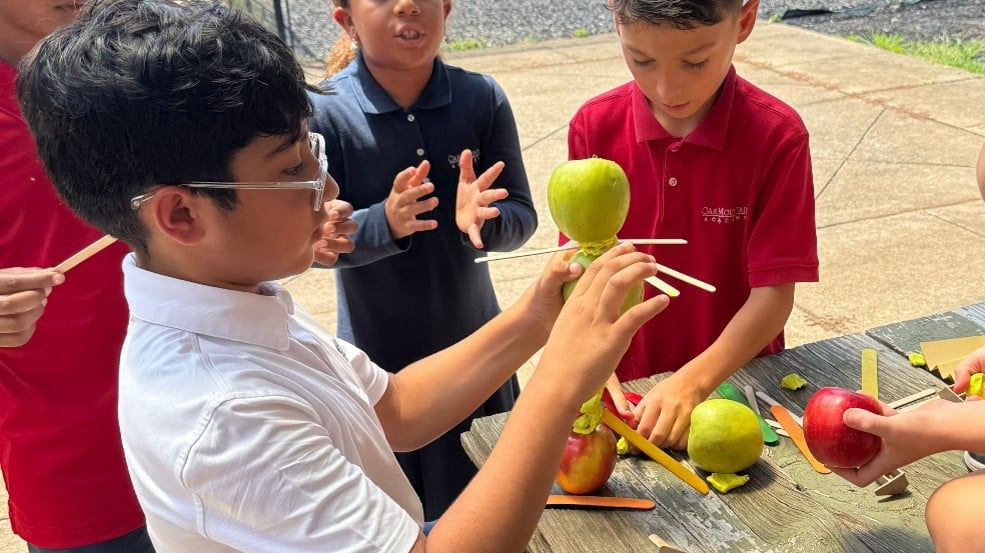
At Oak Mountain Academy, I have had the privilege of helping design and leading the implementation of a unique approach to this human-centered design that we call The NOVA Discover Experience™. In our approach, we focus on making teachers the facilitators of discovery with core pillars of instruction that are rooted in long-standing, sound pedagogy.
Consider the earlier example: teaching To Kill a Mockingbird is not about the thesis statement, first draft, and final paper as outputs. Instead, teachers begin with a discussion with students about times when they have felt brave, even when they knew the odds were against them. Students share their stories, and, subsequently, as they read the text, the moments the characters are brave and stand up to tough odds resonate. Students then read about the author’s life and share their observations. They then consider systems that are poorly designed for the equality students are meant to make. The final part of this process is to collaborate to solve the challenges students identify through observation.
By following this system, the human connection and meaning gets made. The skills of character development and interpreting the author’s experience are still there, but the grading focuses on the process, iterations, discussions, and skill use.
We watch as students experience school differently, guiding us through their learning. In our system, elementary students build foundational tools, while middle schoolers align their passions with their talents, and upper school students create their impact on the community.
We design our system to produce confident leaders inspired to serve because that is what we promise to our community. We put the student experience at the center, watch to see what the outputs are, and then adjust to meet our intentions.
We know this is working each time we see students connect with their content, arriving at school excited to tackle the next challenge. We see it in how our culture shifts and how the students talk about their school experience. We see it when they demonstrate their acquired skills and newfound knowledge, guiding us through their learning rather than the other way around.
Our schools all have their own mission and vision – the promise we make to our communities. Take a look at the systems you already have in place and ask, “Are these systems producing the people and outcomes we promise our community in our mission and vision?”