
Why understanding a school’s unwritten rules may be the first step toward changing it.
Midway through Amir Farokhi’s first year as head of school at the Galloway School in Atlanta, GA, he embarked on a search for a new interim assistant head of school for academics and programs. Though a diverse internal search advisory committee was formed, with thorough vetting and interviewing of final candidates, internal contention arose. The search process had not adhered to unspoken expectations of previous major searches, such as faculty and academic leadership wanting more front-end input on the role and insight as to its purview.
Nothing in Amir’s onboarding would have warned him about these unspoken, unwritten expectations. The org chart states who reports to whom; the employee handbook covers the policies; and the strategic plan lists the priorities. Even Amir’s status as a “lifer” alumnus and former trustee couldn’t adequately prepare him to define the spheres of influence.
We call this the “invisible handbook”: the accumulated relationships, stories, language, and assumptions that explain how a school really works. Every school has one, and most leaders are measured against it before they know it exists.
The Knowledge Gap is Expensive
Nationally, average head of school tenure has fallen from roughly nine years in the early 2010s to about seven and a half today, with median tenure hovering near five years (NAIS). Roughly 1 in 10 schools experiences a head transition in a given year; about one in five new heads follows a predecessor who lasted three years or fewer; and nearly a third of independent schools have had three or more heads in the past decade.
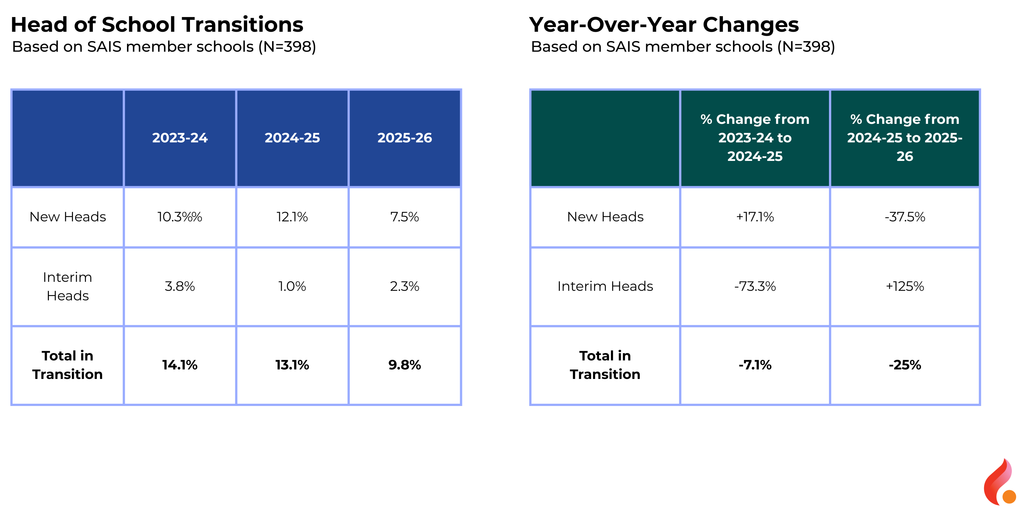
For SAIS member schools, leadership turnover is declining, yet close to 10 percent of SAIS schools experienced head transition during the 2025-26 academic year. While new head appointments for SAIS schools were their lowest in three years last year, interim heads are on the rise once again, which warrants monitoring and may signal unplanned departures or difficult searches.
Misalignment is not always obvious; instead, it is often hidden inside assumptions each party believes are shared. NAIS and the University of Pennsylvania studied the factors behind unexpected head turnover, finding that heads and boards frequently held different perceptions of the same relationship and the same school, and that this lack of concordance exacerbated turnover at every level.
Ultimately, schools pay for the disruption head transitions can cause. Few things are as debilitating to a school as a revolving door in the head’s office, and the stakes are concrete. Leadership disruption is tied to loss of revenue, strategic momentum, and community trust. Premature transitions have been shown to affect enrollment, staff retention, and faith in the institution itself (NAIS). Against shortening tenures, the arithmetic gets unforgiving: a head who spends two or three years learning the rules by breaking them may be most of the way through the job before the real work begins.
At Galloway, we started thinking seriously about navigating the unwritten rules at the end of Amir’s first year as head of school and Natalie’s seventh. Our vantage points were opposite. Amir came back to lead a school he already knew from the inside as an alumnus and former trustee. Natalie found that every new role with increasing levels of responsibility exposed cultural landmines. Familiarity with the school did not make the invisible handbook legible for either of us.

The School Beneath the School
The invisible handbook is where the rules live once people stop experiencing them as rules. It holds the informal networks and quiet spheres of influence, and it sets the tempo of the place: how fast change should come and how long consultation should last. It determines whether a leader’s brevity reads as clarity or coldness, and whether an idea floated for discussion sounds like an invitation or a decision already made behind closed doors.
It also holds the school’s vocabulary, where much of the trouble hides. Schools describe themselves with a familiar set of words: progressive, whole child, classical, rigorous, inclusive, innovative, student-centered. The words feel like alignment, but they often conceal real disagreement. We conducted interviews with heads across the country. At one school, a scrappy origin story had hardened over the years into a settled faculty conviction that the place was progressive at its core. Parents were not necessarily buying that value proposition, and no two people fully agreed on what “progressive” meant in an actual classroom. Everyone reached for the same word, but they were not describing the same school.
Consensus works the same way. A school can genuinely prize a collaborative, inclusive culture without meaning that every decision requires unanimous support. But if no one has ever drawn the line between being consulted, reaching consensus, and giving consent, a leader usually finds that line by crossing it, at a moment when a reasonable decision meets resistance that seems to come from nowhere.
“The invisible handbook is where the rules live once people stop experiencing them as rules. It holds the informal networks and quiet spheres of influence, and it sets the tempo of the place.”
Amir Farokhi & Natalie Pitchford
The Galloway School
History Is Complicated
We assumed at first that a school’s invisible handbook simply thickens with time, and that a school founded in the 1820s would carry more traditions and buried rules than one half that age. Yet, through our interviews, we discovered that sometimes older schools have a history that’s not just longer, but also clearer. What matters is not a school’s age but how it keeps its history.
At some schools, the founder gradually becomes one figure among many, and the institution’s identity accretes through successive leaders, changing communities, and distinct eras. At others, the founder stays in the room long after they’re gone. The founder’s words appear in today’s communications, frame board conversations, and become the lens for judging current decisions.
A strong and lasting founder story can provide a coherent origin, a durable sense of purpose, and a shared language that reaches across generations. It also complicates the handbook. Rival camps summon the same founder to opposite conclusions. The challenge is not whether to honor the founder’s legacy; rather, it is separating the pieces that carry enduring values from the pieces that belonged to a particular moment. Perhaps even more critical is deciding who has the standing to make that call. Culture is hardest to untangle where memory is still personal, still authoritative, and still contested.
Influence Beyond the Org Chart
Schools are relational places to their core, which is why influence rarely runs along formal lines alone. What people know about an institution moves through board-faculty friendships, legacy families, married couples on staff, faculty/staff parents, alumni, donors, and colleagues who have worked side by side for 20 years. Someone with almost no formal authority can be among the school’s most trusted figures, particularly to other community members who also carry long tenures. A decision that looks tidy and self-contained can pull on relationships nowhere near the table where it was made.
In our interviews, several heads described learning to see these spheres of influence: not to let informal networks quietly run the school, but to understand that trust, communication, and resistance travel through channels an org chart cannot show. Ignore those channels and you get blindsided. Lean on them too hard and you trade one problem for another. The same networks that carry wisdom and trust can also shelter entrenched power, hide favoritism, and give insiders a disproportionate say. The real work is to see informal power clearly enough that it does not quietly run you.
The Handbook a Leader Brings
Every new leader shows up carrying an invisible handbook of their own. Previous experiences shape expectations around communication, urgency, trust, and change. Leadership style and history shape ideas about transparency, disagreement, and discomfort. One of the costliest mistakes a leader can make is assuming everyone else’s mind works the way theirs does.
How does this manifest? A leader who communicates in short, efficient messages may believe she is offering clarity, while the people receiving them feel held at a distance. A leader who thinks out loud may believe he is inviting people in, while his colleagues hear each half-formed thought as a directive taking shape. A leader who stays quiet until a proposal is fully baked may believe he is being responsible, while everyone else reads the silence as secrecy.
Even discomfort has to be interpreted. As part of our research, one head told us he had learned to name his own unease with a proposed change instead of treating it as proof the change was wrong, holding the discomfort up as a red flag to pause and consider rather than an automatic stop sign. Sometimes the unease is a real warning. Other times, it is only the feeling of an unwritten rule becoming visible for the first time. Either way, discerning a school’s invisible handbook starts with understanding the one you carried through the door.
Making the Handbook Visible
The heads we talked to offered no single fix, and we do not believe the invisible handbook can or should be erased. Schools are human institutions, and some of what is best about them will always live in relationships, memory, and story rather than in any manual. But leaders can make far more of the handbook discussable than most do, and the heads we spoke with shared concrete ways they have done it, bringing assumptions to light.
New leaders own most of this work. They have to be curious, seek out cultural interpreters, study the history, and ask the questions whose answers seem obvious to everyone but them. But established leaders, boards, and leadership teams have every reason to join in, because surfacing the school culture handbook is more than just a favor to the newcomer. It gives the institution a chance to look hard at itself and ask which unwritten rules still protect something worth keeping, which survive from circumstances long gone, which help people feel they belong, and which mostly guard familiarity, access, or power.
The best leaders will go beyond mastering the invisible handbook. They will help their schools read it together, question it together, and decide together what deserves to stay unwritten.
National Association of Independent Schools. “NAIS Leadership Alignment Project.” NAIS.org, 2026. https://www.nais.org/about/nais-leadership-alignment-project
National Association of Independent Schools. “The State of Head Turnover.” Independent Ideas, NAIS, March 2026. https://www.nais.org/resource-center/independent-ideas/march-2026/the-state-of-head-turnover
National Association of Independent Schools and University of Pennsylvania Graduate School of Education. “NAIS Research: Head Turnover at Independent Schools: Sustaining School Leadership.” NAIS, 2020.
National Association of Independent Schools. Data and Analysis for School Leadership (DASL) and NAIS Facts at a Glance, independent school revenue composition data. NAIS.org.
Pernambuco-Wise, Tekakwitha M. “What Heads Want Their Board Chairs to Know.” Independent Ideas, NAIS, January 2025. https://www.nais.org/resource-center/independent-ideas/january-2025/what-heads-want-their-board-chairs-to-know
Southern Association of Independent Schools, Head Turnover Data, Spring 2026.
6 Ways to Surface Your School’s Invisible Handbook
Practices from heads of school across the country, ready to adapt for your own community